Monday, June 20, 2011

Wherein I Whine a Bit


I’ve been busy. That’s the refrain I hear myself saying again and again to friends and family, to coworkers and even possible collaborators. And it is true, since November 2010, I’ve been focused on making my own artwork.

It’s not always good work, but I do keep plugging away.

And as I work, and am involved in a very different way with the arts scene here in Jacksonville, I’ve come to realize that while it is important to create and sustain a community here in Jacksonville, I’m also very interested in what is happening in other places. How as cities redirect their thinking on everything from “Green Living,” to public transportation it can affect a wholesale change in a city’s attitude towards itself, and by extension, art and culture. That is to say: pressure and change from within and without.

In the past couple of years, as blogs have declined (hello Facebook ascendancy) there seems to be a movement away from the introspection and reflective practices of blogging (ok yes, navel gazing to a certain extent) to a slightly shrill, cacophonous wail that goes something like: “look at me, come to my event.” It’s awfully exhausting.

This hyper-shrill, supercharged involvement with everything all the time does a disservice to art and artists. I’m not saying that I wouldn’t love a city that embraces and supports the arts in a more conceptual and surprising not to mention tangibly fiscal way, but rather, that as artists, thinkers, and makers of things we have a responsibility to honor what we do. To honor the time and commitment to making a piece of work, and not to give it away—to treat the work seriously and still smile at the self. It is not easy, people can be persuasive and honeyed tongues have a way of convincing one that their agenda is best for all even (especially) when it is not.

I also am a huge supporter of finding the ways in which a city is different, and making those work, rather than retrofitting another city’s idea for our own. In the end, artists need to strive for balance: work in the studio, engagement with the community; but only when that engagement is beneficial, not at the cost of the artist.

Do the work, and everything else comes...

Thursday, June 16, 2011

Sublimeness {a new favorite}


Recently I discovered the work of printmaker Andy Farkas. It is exquisite and heartbreaking.

Here's what he says about it in his statement:

"I follow a dog chasing some invisible bird.My work is prayer. It longs to be humble. It makes visible my essence and desire, Makes clear my failure and my joy. It dreams of hope and whispers wisdom. It seeks truth.My goal is to overtake the dog And make visible the invisible bird."

Perfect.


http://www.fablewood.com/ for more of his work

Monday, June 13, 2011

The Things I've Been Up To


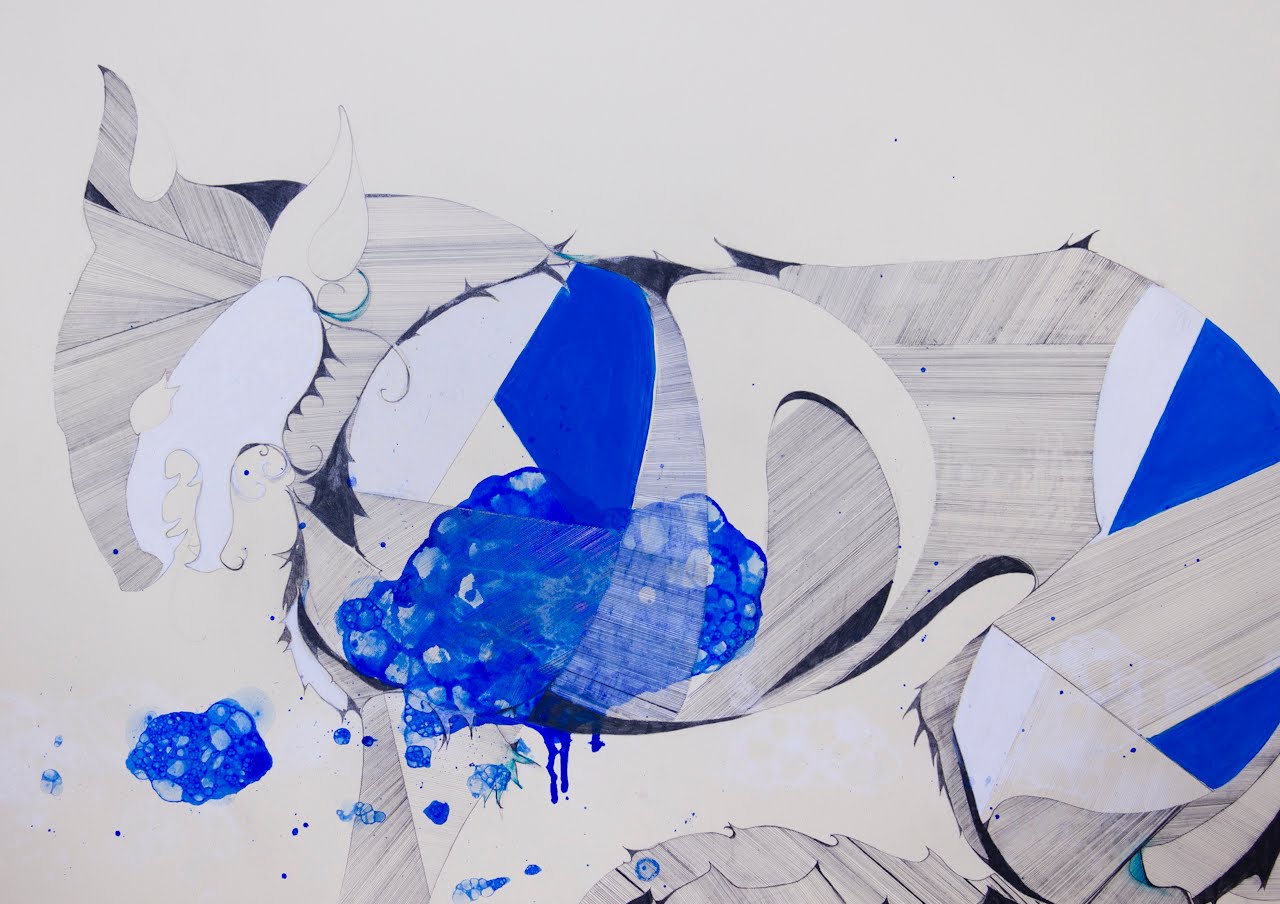
It's been a while since I posted, but I have been busy working on large-scale drawings, so it doesn't leave as much time for the blogging. I miss it, but make no promises of continuity {sheepish smile}.


Monday, December 13, 2010

CAVU Forever


Ten days ago, the last of my grandparents died. Our family was given notice that my maternal grandfather, David Makepeace Poxson had gone into hospice on the last day of November, and I knew this was his last ascent into the skies.

I think the best way to sum up my grandfather is to say that he was a pilot and a story-teller. His was an expansive view of life, filtered through triumph, loss, and history. In the Second World War, he served in the Army and was stationed at Los Alamos during the development of the Atom Bomb. Later, he was at Bikini Atoll when the bomb was tested.

Growing up, it was always common knowledge that grandfather had been at Los Alamos, and we’d even seen the Army photos taken during the test, where if you looked closely, we imagined we could see the ships tossed end-over-end, tiny in the mushroom cloud. But Grandfather never really talked in detail about what he did for the Army, or, what he saw.

That changed over a family Thanksgiving in November 2008. We were sitting around the living room in my Grandfather Peck’s Topinabee house, with my Grandfather Poxson and he (Poxson) started talking about his time in the Army. As he spoke, and he could weave a tale even out of the simplest day that left you hanging on every word, he talked about what it meant to guard the “raw material” used for the bomb-making, how the scientists worked with the uranium (inside “little lead houses to prevent radiation leaks"), and what happened to one of the scientists when one of the doll-sized houses toppled. Radiation sickness is a horrible way to die.

Grandfather Poxson also talked about the spare, aching beauty of the Southwest, told us that for a while, he’d considered moving out there, and how, he wasn’t surprised that New Mexico is where my brother now makes his life. He told us about driving the "material" through the then, very bumpy back rodes of NM, how he and his fellow soldiers sweated those rides out, and how, though it in some ways seemed absurd, how his unit was keeping watch for spies and other unauthorized persons.

Then he told us about the explosion. For him, I believe, it was a life-changing experience; one that informed many of his choices after he returned to civilian life. He spoke quietly as he talked about the awesome power of the bomb, of seeing mighty warships blown into the air, and even one exquisitely beautiful Japanese Junk that was simply evaporated upon detonation. Even in his 90th year, he could describe the Junk as if it floated before him again. As he told his story, you could see him remembering the terrible power unleashed that day, and I believe, he then returned home to Michigan, and dedicated his life to protecting that which he could.

Our family has owned property in Northern Michigan for about a century, and it was to this land, and a tiny, four-room cabin (the Stone House), that he ultimately returned to. He spent his life protecting the land, as a member of the zoning board, and even in his late eighties, was forcing environmental and building compliance upon those who would deface his woods. When a neighbor poured a concrete slab that drained into the lake instead of using gravel, or just leaving a grass impression, he stood nose-to-nose with the millionaire offender, and said, “Go ahead, pour the slab, you’ll just be pulling it out tomorrow.” And he won.

The destruction he witnessed that day at Bikini, I think never left him, so he decided –perhaps- to work against it. How long his physical legacy, the land, will hold, I don’t know, but that righteous willingness to articulate and maintain beliefs, I hope and think is the lastingest part.

My grandfather was a sailor, pilot, wood-chopper, hunter, recipient of a Master’s Degree in English (story teller), and a connoisseur of pies and sour-dough pancakes. He was as exquisitely made as the Japanese Junk he so admired: David M. Poxson 1918-2010.

Monday, December 6, 2010

Every Body Loves Art Basel


I just got back from my second trip down south to check out Art Basel Miami, and I can say, without a doubt, it is worth the trip.

This year's fair seemed even more buoyant and expansive than last year's. As a the overwhelming backdrop to everything, there was Phu Hoang's and Rachely Rotem's surprisingly poetic rope sculpture/arial installation that anyone with any friends in Miami has surely already seen photos of.

This year, instead of mapping out marching orders, I took a more organic approach, letting one event lead to another, with a few pointed stops along the way. Of course, it's really worth noting that I stayed with some friends who were wonderful, accommodating, fun hosts who really love their city. They took us on a kind of mini-tour of Miami, and I've come away with a deeper, semi-profound love of the city, which so sharply contrasts with our own.

It's not just that Miami is beautiful, and populated with a diverse, beautiful population, but rather that Miami has practice saying "yes." Whether it is to an all night party on the beach, or, to an art fair that transforms the city for a week in December. Recently I was asked to participate in a video project of Dolf James's; he wants to get people talking about why Jacksonville is great, or at least good. And for as long as I've lived here, the one thing I've said is that here, you can kind of decide you're going to do something, and just do the damn thing. It's kind of like the wild west in that manner, but also like the west, there isn't a whole lot of support structure in place (also like those olden days, often, if you've got a big enough "gun" one can convince people of an otherwise unwarrented, er, grandeur).

So this city often finds itself at odds with its own self. Of course, it doesn't seem to help that Jacksonville (from my perspective) has a habit of pouring funds into absurd, useless projects, and then, when there are no more funds left, crying to the creative community to help create something else, but now I digress.

This year in Miami, I visited the Rubell again, and wasn't as bowled over as last year, this year, I thought the break away show was Scope, specifically the artist Enrique Gomez de Molina. His attention to detail, scale, and willingness to work with what otherwise might be considered repulsive materials piques the curiosity, touches on ideas trophy and destruction, and is often seductively beautiful. In the rhino bust (pictured), the artist covered a rhino mould with thousands of iridescent beatle wings. It was exquisite. I wanted to sell my house, purchase the piece, and move in with it under a bridge.

Then there was Mr. Anthony Lister. I've been a huge fan (no other word for it) of his work since I first started seeing it on Wooster Collective years and years ago. His sure but hurried application and use of multiples within one image struck me as a really modern solution to figuration and narrative painting. This year he was all over Miami. With three murals and two shows, he was clearly working hard, and from the extraordinarily brief conversation I had with him, I'd say he was enjoying himself quite a bit (and was probably a little exhausted).

The same day I saw Lister (at a little LISTER pop-up gallery, and again at the Hello Kitty show), I got to see the Margulies Collection where in addition to seeing L'Hospice (Superhero Nursing Home), I was captivated by Pieter Hugo's photographs of Nigerian Gadawan Kura (Hyena Men). Incredibly formidable, the images immediately strike the speculation of the viewer: what kind of people tame hyenas (and baboons)?

As a little research shows, a family of performers who've been passing down the hyena secrets for generations.

Taking Art Basel as a whole is near impossible. Rather, I say make it to a few of the things your friends tell you not to miss, wander into a few unexpected spaces, and snack your way through the city (there was the taco truck outside of Rubell, Sugarcane near Scope, Prima Pasta in Miami Beach, Caminito Way in North Miami, the Chow Down Grill in Seaside, or any of a host of little pop-up snack places near the fairs).

This year, Art Basel was food, laughter and beauty. I can't wait to return.

Now, I'm gonna go eat the bagel I hauled back.

Wednesday, August 18, 2010

Butchie {Frank O'Hara}


A long time ago I read Larry Rivers' autobiography (thank you Kurt). In it, he talks about his friendship with the poet Frank O'Hara. Fast forward five or so years, and I stumbled across Brad Gooch's City Poet, The Life and Times of Frank O'Hara.

O'Hara was primarily concerned and involved with the second-generation of abstract expressionists, and the early pop artists. He worked as a curator for MOMA and wrote poetry. He wrote prolifically, profoundly, and occasionally with an arch bitchiness that was as much a part of the literary scene in the '50s and '60s as it was the east coast gay scene. Called Butch when he enlisted in the Navy because he was kind of tough-looking, his fellow sailors were affectionately calling him Butchie by the end of his tour.

Like the nerd that I am, as I stumble across bits of his writing that I really love, I jott down a few of my favorite snatches and excerpts. And since I'm not in Jacksonville to gossip about what's happening there, nor have I yet made the Cleveland rounds, I thought I'd post them here:

From a letter to Larry Rivers, from O'Hara at the conclusion of their affair (they continued to be great friends until O'Hara's death in 1966--he was run over by a beach bus on Fire Island at 3 a.m., and by the time the physicians figured out he was bleeding internally, there was nothing to be done).

"But the worst thing of all about being rejected is the grotesquerie, it sits on one's back like a hump, a horrid tumor, which cannot be shaken, or cut off, or wished away. It is. And there is no making it not what it is."


Digression Number 1

Stars are out and there is sea
enough beneath the glistening earth
to bear me toward the future
which is not so dark. I see.


Naptha (written after the poet saw Jean DuBbuffet's 1959 MOMA show)

Ah Jean Dubeffet
when you think of him
doing his military service in the Eiffel Tower
as a meteorologist
in 1922
you know how wonderful the 20th Century
can be


That'll be all from me here today...I may post about my Michigan Experience over at ...belief in invisibility...

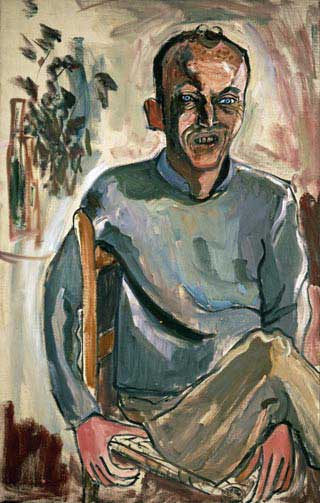
* first image: Alice Neel painting of O'Hara
**third image: a drawing of O'Hara by Rivers.
***fourth image: one of the results of the collaboration between O'Hara and Norman Bluhm


Monday, August 2, 2010

The Price of Gold


So, although I haven't been posting about it here, I have been watching the Bravo-channel show, Work of Art, and it's worse than a train wreck; somehow they've managed to tap into every insidious stereotype about artists and run with it. And I don't think it'd be so bad except for two things:

1. It's pretty apparent who is going to win.

2. Not only does the winner walk with a hefty sum, but also, a solo show at the Brooklyn Museum; an amazing space for any artist, let alone a contest winner, to show in. But maybe that's my jealousy leaking thru.

That being said, do I want to compete? No, and no least because the time constraints seem pretty arbitrary...barely enough for the paint to dry (not that very many of the competitors are painting), but also, in my case, more exposure means lots more chances for me to make a fool of myself with self-aggrandizing proclamations and tiresome artists' statements (plus, I really could stand to lose a few pounds; chubby doesn't film very well).

That being said, there are a few Jacksonville artists I'd love to see compete. On top of the list: Lee Harvey.

I count Lee among my oldest friends here in Jacksonville, and one of the earliest supporters of my art and later, my writing. I've been seeing him more and more lately because he likes to drink coffee at my neighborhood Starbucks, and every time I see him I come away thinking. Whether we always agree is another thing; he says provocative, sometimes outlandish things, but there's generally enough in our conversation so that upon arrival home, I {at least} google the price of gold.

Lee would be, I believe, the perfect contestant to have on this art show. He's smart enough to know it's all a sham, and to give to producers a run for their $$$. He works fast, and has an established visual lexicon within a larger practice not just of making paintings (though they're his primary focus), but of making things. Plus, Lee's been known to get into the odd fight, and not just ideological. He'd probably never do it--he values his privacy these days--but I think the results would be grand.

And at least if he won the $$$ and the show, we wouldn't hate ourselves in the morning.

* above image (Marie Antoinette Big Blah) used without permission from Lee Harvey Inc.

Monday, July 19, 2010

Renewal and all that Jazz


So it's been months and months since I posted here. But I find that though I have a sparkling new blog over at wordpress, I can't quite quit thinking about stuff over here. Admittedly an odd notion since there really isn't a sense of space of place on the interwebs, but I kind of can't help it.

It feels right here.

So, the long and the short of it, is, I think I am back. Not least because every time I watch That Art Show on Bravo (Work of Art), my blood boils at the thin, and boring "crits" each artist or team gets. Take for instance this past Weds (14 June 2010). The contestants were divided into two teams to create a public art piece. And after so doing, during the "crit," on the most basic, kind of sweeping level, none of the judges mentioned either Turrell, Smithson or Judd...are the producers so committed to perpetuating the "artist as genius" myth that they overlook obvious, recent, antecedents?

Hell, even on Project Runway Kors or Garcia will stop a contestant in their tracks when they too closely or obviously riff a previous collection.

*pictured: top Scales bottom: Nuematon (winner)

Monday, March 29, 2010

Tata Jesus is Bangala

I just finished reading The Poisonwood Bible. I read it at the recommendation of a friend, and besides the tragic beauty, and inherent compellingness (is that even a word?) of the story, I can’t help but think how all of us, in one form or another, carry with us our own Bible of wounds, worries, and wonder.

The story itself follows the lives of four girls, their mother, and their father (Reverend Nathan Price) as missionaries in the Belgian Congo in Kilanga--a small village on the Kwilu river--before, during, and after the democratic elections, which were quickly followed (as suggested in the book) by a U.S. backed military coup (we don’t like Ike!).

Told in the voices of the five women, the book details the sublime mistakes this family from Georgia makes while trying to spread the word of god and bring ‘light’ into the wilderness.

It’s a sideways look at colonialism, and a pretty strong argument against it. Showing how people get swept up in issues and events larger than themselves. This does not absolve any of the characters from their mistakes, but rather, like the best novel it humanizes them.

Perhaps the best example of the misunderstanding and arrogance is Reverend Price’s continuous and unwavering assertion that “Tata Jesus is bangala!” (father/brother Jesus is precious). However, due do subtle variation in the way certain syllables are stressed or not, bangala can either mean the intended: precious, or, is the name for a poisonwood tree. Mostly, Reverend Price gets it wrong, and so his attempts at conversion are less than successful.

Though the family only lives in Kilanga for 18 months, it changes their live irrevocably and really, Kingsolver suggests none of them ever leave Africa completely behind.

I mention this story and these themes here because I think it is time for me to relocate this blog. 2009 seemed to go on forever, and so this blog became less a repository of observation, and more a cry into the night. Looking over some of my last posts, I realized that Art Isn’t Rocket Science is bangala too. It started out as something good and precious to me, but now I see it, if not as poisonwood, certainly as a chapter that must end.

I feel like this blog has become less a place of sanctuary and humor, and more like an invisible anchor around my neck: I feel guilty for not posting, but when I do it’s all this navel-gazing, whiney shit. So, I’ve made the decision to end this blog, and start a new one over on wordpress: ...belief in invisibility.... The new blog will include some of the more personal essays this one has come to encompass, and the focus will still be art and culture, but hopefully with a slightly less evangelical bent.

Tata Jesus is bangala!!

Thursday, February 11, 2010

Dreams Answered: Marilyn at MOCA


"Dreaming about being an actress, is more exciting then being one." --MM

Last night Marilyn, Forever Blonde made its Jacksonville debut. I’d interviewed the lead, actress, Sunny Thompson for EU, and hearing her talk about playing Marilyn, and the steps she’d taken to inhabit the character really roused my curiousity.

But in truth, I would’ve gone to see the play anyway. It’s not that I am a huge Marilyn Monroe fan, rather, I am fascinated by the phenomenon that she and celebrities like her represent. Especially in light of a recent viewing of This Is It. Watching Michael Jackson work through his rehearsals, interact with members of the troupe and production team, and the props scheduled for the tour gives the viewer a glimpse into the way his mind works, and, the way the MJ public persona was always in place. Even when planning his interaction with the audience, those same gestures are again found in his semi-private interactions with his crew.

So too, in Forever Blonde, does the audience see a Marilyn that is both real and artifice; a self-made, deliberate, creature and a real person with deep flaws. Sunny Thompson bears a striking resemblance to Monroe, but what really brings Marilyn to life is the voice…from her first utterances on her early days in Hollywood to a drunken semi-rage against her final ex-husband and her failure to succeed as a “serious” actress, the voice carries the weight of one-thousand pop culture memories.

Marilyn as an icon has completely eclipsed Marilyn as a person. And while there is the endless speculation of her influence as a cultural touchstone and symbol, to get a glimpse behind her veil of celebrity of enlightening and frustrating. Thompson so completely inhabits the role of Monroe there is a hallucinatory feeling of being in two places at once: the present, where one belongs, and Marilyn’s final photo shoot.

Ultimately though Forever Blonde invites speculation and navel gazing about a celebrity obsessed culture, it is a reminder that the famous, no matter how asisine and absurd are people too. Sometimes {just sometimes} they deserve our compassion.

Marilyn, Forever Blonde plays through March 7 at MOCA, the exhibit it accompanies, Life as Legend, Marilyn Monroe runs through April 4.

Friday, January 29, 2010

New Bar Sneak Peek {let's go to the lodge}


Last night I stopped by the old Steamworks/new Lodge. Ian’s got Sean Thurston painting a series of “trophy heads,” on the wall in true hunt lodge/man cave style, and so far, they live up to the reputation Sean has established for himself. Highly rendered, balancing humor and design, the new pieces are looser than some of Sean’s previous works, but he explains, “They’re meant to be seen in low, bar, lighting.”

In addition to the mural (which is likely to be the focus of the space), Ian and Maryanne are upgrading the bar amenities, and adding a smoke eater that works. They project that the bar will be open towards the end of February/beginning of March.

We {I} wish them tons of luck and success!

Here’s a link to Ian talking with Joey Marchy and Tony Allegretti.

Thursday, January 28, 2010

Portents of Goodness


So I’ve talked a lot about how this past year was full of difficult family stuff. That while I was attempting to move in a new direction (and receiving some good feedback) emotional roadblocks kept throwing themselves in my direction. But I’m not the only one, 2009 was tough for most of the people I know.

In my first post of 2010, I hoped that 2010 would be a better year. And so far, that hope is bearing modest fruit. This past summer I had the worst vacation ever. I went to the family cabin in Northern Michigan, and not only is the cabin in horrible, uncomfortable shape, the weather was cold and rainy, and, I picked a screaming fight with my father then ran out of the house crying. Though my father and I made up, it was with a lot of trepidation that I invited my parents down here this past week. My nervousness was unfounded.

Though I think my parents could possibly send the Dali Lama into screaming fits of frustration, this trip went really well. The weather was mild enough that we spent most of our days walking the neighborhood and beaches. But the highlight of the trip was our excursion to Cumberland Island. For years my friends have been telling me what an amazing place the island is. But me being me, I seem to always think that tomorrow is when I’ll go have a Cumberland adventure. However, when I mentioned it to my family, my father said he’s been wanting to go to the island for 30 years. So we went. And it was an amazing, transformative experience. I think my family and I will remember it as one of our best times together for the rest of our life.

So, thus far, 2010 has started auspiciously. Hopefully the trend will continue.

*of course, that's not to say that there weren't moments when I wanted to scream, or, I'm sure, my parents thought me pretentious and a little OCD. But, if your parents define who you are (whether you react against them, or in line with them) the more I can be compassionate in my dealings with my own family, the more I can be compassionate with myself.

Wednesday, January 20, 2010

art nobody uses


"“I am a fisherman of social absurdity, if you will… My focus is to politicize disenfranchisement, to make it neut, to reinvent what’s beneath us, to remind us where we all come from." WPL

I got this from Mark Creegan today: nullspace, a new art gallery / studio has opened at 108 East Adams Street Jacksonville, FL, 32202. Curated by its owners, Mark Creegan, Kurt Polkey, and Jefree Shalev, the inaugural show, presented by the Leon Castelli Group and titled "Art You Can't Use," will take place on Friday, January 22, 2010 between the hours of 7 pm and 10 pm. Show runs thru Feb 19th

A brief description of the show: William Pope L is an iconoclastic performance artist whose themes include economics, race, disenfranchisement, and cultural values. Using Pope L's life and career as a jumping off point, Mark Creegan, Kurt Polkey and Jefree Shalev will bring drawing, performance art, installation and video together to create a cohesive jumble of ideas around those themes.

On a personal note: the other day I dropped in and talked with Jefree and Kurt for an article I am putting together for Arbus. Suffice to say that lots of things were said that will never get printed. However I came away from the space with the distinct feeling that even if people are extraordinarily critical of what goes down there, they’ll be happy.

Jefree and Kurt talked a lot about the need for a space that isn’t driven by revenue needs. Formerly it’d be safe to say that SeeSaw occupied that niche. But as the economy boomed, space itself became a commodity that few could afford to use for an experiment. Now though, through the Downtown Vision initiative, Mark, Kurt, and Jefree are able to give space to their thoughts (they describe themselves as a for-profit gallery with a non-profit attitude).

I hope to stop by this Friday…with my parents in tow.

www.nullspacegallery.com

*above image taken from one of William Pope L’s performance pieces {I believe} from his eRascism project.

Saturday, January 2, 2010

In Closing...


Looking back over 2009, I am amazed at how much I got done, and how much more I feel like I have to do. I’ve been telling friends and acquaintances that 2009 was one of the most amazing years of my life…in the same way that in 1939, Hitler was Time’s man-of-the-year.

2009 was both incredibly challenging, and rewarding. I traveled more than I ever have, to places I am intimately familiar with, as well as the brand new. I discovered a love of, and affinity for, the open road. Though I liked driving for hours alone in the Texas Panhandle, and even more through Northeastern New Mexico…I also discovered that I am the kind of traveler badly in need of a control room: on the way out to Santa Fe, I managed to lose my glasses (still had my prescription sunglasses), and on the way back (in Amarillo), I managed to leave my purse—full of everything I needed to live--on a hotel counter top because I left in a panic to outrun a snowstorm. By the time I outran the storm, 100 miles later, I realized I’d left my purse behind...a calling card of absent-mindedness. Luckily, the motel where I stopped trusted me to get the cash and pay them the next day, and my (now) husband wired $$$ to the local Wal-Mart.

Since the snowstorm was so bad, all the roads heading back to Amarillo were closed, but the people at the La Quinta were kind enough to mail my purse back to me. Everything intact.

2009 also brought with it several devastating events that I’ve mentioned here and it took me until October to realize that I am still kind of processing them. Not just the events, but the change they wrought.

Perhaps most auspiciously, I got married to Nick Wagner this May, and that feels like the right thing to have done, though now when he’s being absurd and I am haughtily looking down my nose at his antics, he just reminds me that I married him…and therefore am partially culpable. Nice.

I also finally made it to Miami during Art Basel, and though it’s an overwhelming event, I was pleased that I left it feeling more energized about the future than weighted down with that insidious thought, “everyone is an artist.” It was also at Art Basel that I hit my first-ever Bullseye playing darts. Perhaps that contributed to my buoyancy…

More recently, I tried my first recipe from Mastering the Art of French Cooking. And though I can honestly say I did not see Julie and Julia until after I’d read Julia Child’s My Life in France, the pervasiveness of the movie did excite my curiosity, and therefore inspire the gift (Mastering was a part of Christmas). Thus I am a part of the cadre of home-cooks inspired by the movie and rushing out to by their own Le Creuset pots and attempt French cooking…we’ll see how it goes.

But back to the recipe: Quiche aux Oignons (onion quiche). Made with 2 pounds of sweet Vidalia onions, cream, and eggs, the result was more like a desert tart than a main course. So rich, we could only eat a tiny slice at a time, it exemplified the notion of technique vs. ingredients. How such simple--humble really--ingredients can transform into something so incredibly decadent was an object lesson in patience (the 2 lbs took an hour to cook down) and simplicity. Hopefully one I can bring into the New Year.

Plus it’s nice that 2010 (the numeric arrangement) has such an appealing, visually balanced quality…it can’t help but be a good year right?

Monday, December 21, 2009

Donut Holes and Art Basel


This December I finally made it to Art Basel, Miami. For the past five or so years I have been traveling when Basel comes to town, so I missed it. Heading down south this first time, I must confess to a kind of country-mouse-going-to-the-big-city-nervousness. I must also confess that I fully expected I95 southbound to be clogged with travelers headed south to Miami. But then, a friend reminded me that as important as Basel is, it is still “just art…” Suffice to say my assumptions were incorrect on both parts.

The main reason I wanted to head south was to goggle at Jenny Rubell’s donut installation. I’d read about her food/opening/installation for the Performa 09 Biennial: an “interactive culinary experience,” based on the book of Genesis. The goal was: Five hundred guests moving through three floors, eating a course on each. Honey will drip from the ceiling onto 2,000 pounds of barbecued ribs (think: God creating woman) and guests were asked to destroy and consume chocolate facsimiles of Jeff Koons's bunny sculpture (made by Jacques Torres).” Interspersed in the exhibit were 1,000 lbs of peanuts in the shell, drinks served in assorted Mason jars, and full-sized apple trees felled for the exhibit.

When I first read about this great festival of consumption and destruction, several thoughts occurred rather simultaneously:

1. She’s using food that though uniquely American, is regionally Southern. Ribs, peanuts, Mason jars, even honey evoke a specific image of a non-specific place.

2. It’s the time of year when people turn towards large, communal feasts…the desire to dress in spangles and glitz at odds with the primary activity of the season: eating and drinking.

3. The communal, almost primitive nature of gnawing flesh of ribs, of licking honey of fingers, melting chocolate in hands and bits of peanut clinging everywhere as in direct opposition to the “white walled” gallery.

When considering these elements, I really like (there’s no other word for it) the concept. My only objection (and this probably reveals more about myself than the artist or the work), is the point of departure. That is, I feel as if the use of Genesis as explanation is a little on the nose. The use of food often associated with the Bible Belt, to evoke a deeper sense of Americana seems like it might not need the added presence of Genesis. But, I wasn’t there. And Rubell’s own statement, “the idea of being human is more important than the idea of being perfect,” is elegant and inherently forgiving…perhaps seasonally appropriate?

So it was with great excitement that I scurried into the Rubell collection, and upon spotting the donut installation, “Old Fashioned,” at the back of the space, headed in that direction, in the process almost bowling over Val Kilmer, to snatch my piece of interactive installation glory. The donut was kind of stale. And I liked the back of the exhibit better than the front.

Though “Old Fashioned” had a kind of digital gridlike appeal, balanced against the myriad imperfections of the donuts themselves…it lacked the oomph I was hoping for. However, I can’t be too dismissive, Rubell had fresh donuts brought in every day before the collection opened to the public, and had to find an edible solution to a problem that included Miami heat, the hoi polloi, and blue-chip art. So though it may have lacked the pomp and circumstance I was looking for, as a kind of gentle, sideways nudge in her NYC direction, it was successful.

Sunday, December 20, 2009

Printed v. Posted...a few rambling thoughts


I’ve been thinking a lot about how blogs function…more specifically, the people for whom they function. When I was working full-time in an office, my blog—and the blogs of others were a way for me to feel connected to a greater community, to feel like I wasn’t actually isolated in an office, but instead, thinking important thoughts about interesting things. Then to use the online forum as a way to sort out my thoughts, or to post observations I’d made at shows.

However, since I no longer work in an office setting, my connection to the online world is more sporadic. When I write, I of course spend time scuttling back and forth between the job at hand and, say, the NY Times. But as far as reading material goes, I find myself returning to the printed word. To those items you hold in your hand, mark with whatever paper is handy, and perhaps jot down notes.

Then, when Josh Jubinsky began creating a Zine collection for the library, I was forced to consider the matter of the printed word vs. the online word. And though I’ll never decry the ease, convenience, and speed the interwebs grants us, I must confess to a knee-buckling weakness for the printed word.

Even Zines, with their often scrawled, hyper-articulated screeds are inherently more interesting and successful than the most erudite and elegant web page. And not just because it is something you hold in your hand, but because it takes a kind of fearlessness and confidence to commit things to the printed page. Especially, when it’s a self-funded project printed by a Xerox machine on hot pink paper, accompanied by shaky line drawings.

I’m curious to see if, in the following few years, we (as a culture) see a ressurange in self-published documents and manifestos. Then again, I might be romanticizing the whole thing (and Kindles will take over the world).

Friday, November 20, 2009

The Baroness

In an aviator's cap and striped suit of her own design, circa December 1915.
Posing/performing circa 1915-16.
Portrait of Bernice Abbott, circa 1924.
Brittany Murphy as the Baroness in a shoot for the New York Times Magazine, circa 2002.

Orpheus reference, circa 1915.

It’s funny, just I am being called out for letting my blog limp along… I’ve been working on a more cohesive essay. It certainly is true that since this summer, my posting has been {ahem} sporadic. But there were quite a few things going down that I needed to tend to. And though I’d like to think that my recent activity prefigures a return to writing, in truth, I can make no such claim.

All I can do is what I’ve always done: advocate for working, thinking, and telling jokes.

This summer, instead of steadying my outward gaze after things shifted, I began to look inward. I began a slightly compulsive and utterly self-indulgent journey through art time. That is, I started with Hemingway’s A Moveable Feast and moved my way through several biographies and biographical sketches of many of the people living in post WWI Paris, characters who’d been referenced in “Feast.” Individuals who now are so deeply entrenched in the canon of 20th Century Art (caps intentional), that is almost impossible to think of them as living, breathing people.

But they were. And they were as deeply flawed, perhaps more so than the rest of us. And so, not only is it instructive from the art historian’s perspective, it’s instructive for actively practicing artists to see that things like living situations, money, recognition, and the struggle to find balance between vision and market are issues modern artists have always been forced to deal with.

But I digress.

In the course of reading many of these biographies, one person’s name kept popping up as an aside, as a kind of internal joke, cited as equal parts inspiration and damnation.

The Baroness Elsa von Freytag Lorninghoven, was born in 1874 in Swinemude, Germany. She was older than many of her later friends and lovers, and writer Irene Gammel cites her as a living example of “decadent old Europe.” While discussing “old Europe’s decadence,” it is worth noting that Elsa married her title—she was not born to it. But even after she divorced the Baron, she kept the title.

Gammel’s book, Baroness Elsa: Gender, DaDa, and everyday Modernity, examines von Freytag-Loringhoven’s life through the lens of feminist theory with gender overtones. That is to say instead of letting the Baroness’s work (poetry and assemblage for the most part) and “performances” speak for themselves, Gammel goes as far to equate Elsa’s voracious, aggressive sexuality with a conscious prefiguring of the role of women in the 20th century.

Baroness Elsa, filled as it is with biographical details, photographs, and poetry is a valuable, if curious source of material that presents a decidedly less favorable view of some of art history’s favorite heroes. But therein is the crux of my disagreement with the book…while creating in the Baroness a figure of sexual heroism and freedom, Gammel’s book also seems to inherently take to task those surrounding Elsa. While at the same time, revealing that Elsa herself, after seducing or “sexteaching” her companions then took this as a sign/agreement that they would support her, and continue to do so even after they split. Opportunism anyone?

While overall the book is extraordinarily researched, and makes one reconsider the origins of some of Duchamp and Man Ray’s breakthrough pieces (she is rumored to be the model in his 1921 Coat Stand and there is circumstantial evidence that suggest she sent Duchamp his urinal), as well as the importance of DaDa and the origins of the Little Review, it does seem to vacillate between a shrilly self-righteous tone and one of hero worship. Consider this passage describing a photograph of the aging Baroness en costume*:

“Her Joan of Arc helmet of hair is decorated with an oddly feminine headband like the one she wore in Lechter’s Orpheus. Surprised by the camera in midpose, her body is bent over; her self-made chiffon dress reveals the nude body underneath. The viewer gleans a look at her strong athletic legs and her extended back; her feet are tightly wrapped in ballet shoes laced around her ankles, the right foot posing on the toe, as if she were a ballerina. Her studio surroundings look makeshift, as if to announce that creative élan arises in the midst of chaos […] here we find the paraphernalia of her performance art, evidence that by December 1915 the Baroness was performing herself. She has already fully developed her trademark personality: caustic, vitriolic, daring, pushy, confrontational, shameless, shocking, and aggressive.”

*pictured above, labeled Orpheus reference.

Insofar as the very act of writing about something is a tacit acknowledgement of it’s power, this passage, especially when contrasted with the image to which is refers seems like a stretch.

The image could just as easily be read as an aging, mentally ill woman descending deeper into her own psychosis. Living in chaos and filth and because of her personality traits, combined with her list of talents friends, has drawn someone onto her own pathology…if even for an afternoon to photograph her. Of course, it is equally possible that an enterprising photographer sought to capture her on film because of her extraordinary circumstances...high drama and banal craziness all in one.

Consider the description with which Gammel follows up her interpretation of the Baroness posing in a chiffon curtain: “Louis Bouche tells us that during this early period, the Baroness ‘lived in total disorder in the Lincoln arcade buildings with an assortment of animals, mostly mangy dogs and cats.’”

It is not von Freytag-Loringhoven’s creative output (especially her poetry) or her streetside “performances” that are being taken to task here, or even questioned. Rather, it is the tendency of writers and art historians to elevate the mundane and unpleasant facets of an individual’s life…to give them undue, unwarranted significance thereby undermining the very institution (academe) for which they stand.

Certainly it is true that Baroness Elsa prefigured performance artists like Leigh Bowery, Michael Alig, and Soigne Deluxe. In addition to breezing through the lives of the “Paris set,” (but first in NYC) who eventually found themselves to be international darlings, she no doubt struck a blow for feminism, art, and fasion. But in ascribing noble motives and heroic strength to her every move, it devalues what she actually did, turning her—and by extension the writer--into a parody of feminist thought/action.


Tuesday, November 17, 2009

Atlantis


I found this image on my friend Yvonne Lozano's Facebook page, from artist Mary Atwood. I love how the grandeur of the smoke/exhaust contrasts with the small determinedness of the shuttle itself.

Of all the things our government wastes money on, I am down with NASA.

Monday, November 16, 2009

Foundness


I found this on youtube, from one of my favorite young photographers: Dana Goldstein (here). It reminds me of roller skating backwards.

(forward to the one minute mark for the impatient).

Wednesday, November 4, 2009

OUCH or painting is ever the challenge; the goal


Damien Hirst's new paintings are being panned left and right. Without proper access to them (or to a good magazine reproduction, it's hard for me to say what I think. Though I think I like some of the ideas and direction...the paint handling itself seems tight and fussy, and not in a good way (but that judgement s made through online slide-shows...not the best representations).

Either way, reading the press surrounding the new stuff (especially the vitrolic British press) is satisfying in a biting sort of way.

Here are the fun-filled links:

The Guardian

The Observer (via The Guardian)

Time